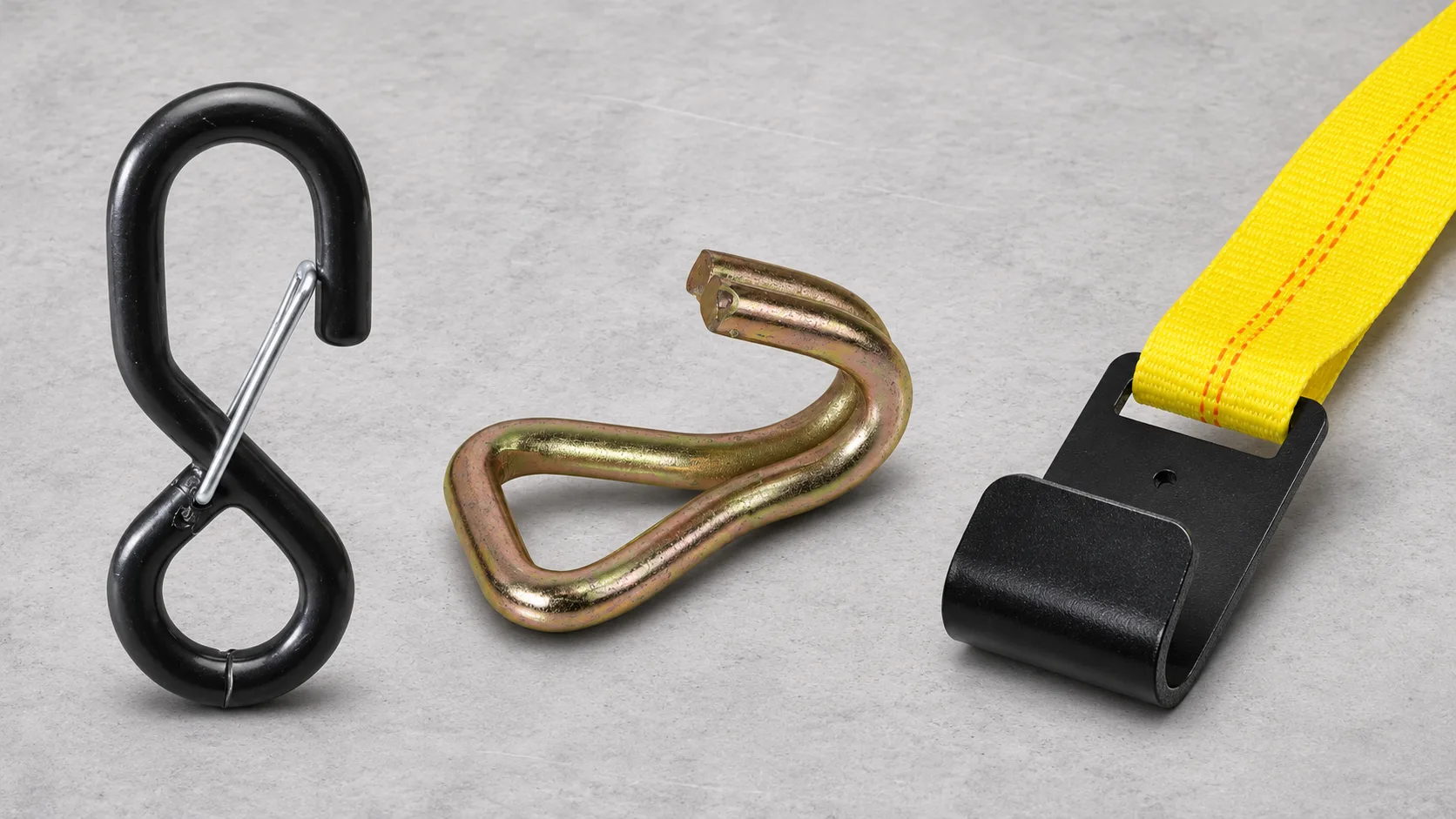
Choose a tie-down end fitting by matching its shape, bearing surface and permitted loading direction to the actual anchor—not by selecting the hook that simply fits through an opening. S-hooks, J-hooks and flat hooks connect in different ways, and each must be evaluated as part of the complete strap assembly and securement system.
For distributors and private-label buyers, a useful specification includes the anchor's dimensions and orientation, the intended strap path, any closure or retention feature, and the manufacturer-assigned working load limit (WLL) of the finished assembly. A hook's individual breaking-strength figure does not automatically establish the rating of a strap made with it.
Begin with the anchor, not the hook name
Identify the actual attachment point on the vehicle or cargo and the direction in which the strap will pull. Record the anchor's opening or accessible edge, material thickness, contact surface, surrounding obstructions and condition. Ask the vehicle or equipment manufacturer which connection points and load directions are suitable for the intended operation.
A hook that enters an opening can still be incompatible if it bears on the wrong part of the anchor, contacts an obstruction, cannot seat fully, or loads a gate or keeper in a way the fitting was not designed to accept. The anchor, its supporting structure and the complete tiedown must be appropriate for the application. Resolve uncertainty with the relevant manufacturer or a qualified person before use.
For US commercial operations covered by federal cargo-securement rules, the FMCSA cargo securement overview describes requirements for the complete system and its attachments. This guide helps buyers ask fit questions; it is not an approval for a particular anchor or a strap-count calculation.
What distinguishes the three hook families?
### S-hooks
An S-hook has a curved profile with an attachment area for the strap and an open hook end. Designs differ in shape, throat opening, coating and whether a separate keeper or latch is fitted. Buyers should compare the actual hook drawing with the intended anchor opening and confirm where the fitting is meant to bear.
The production range includes a cam buckle strap with S-hook. Use the listing to identify that configuration, then request its current assembly specifications and instructions. A product title's breaking-strength figure is not a substitute for the manufacturer-assigned WLL of the complete strap.
### J-hooks and wire hooks
J-shaped fittings curve around a connection point. Some designs use two parallel wire sections and may be called double-J or wire hooks; terminology and geometry vary by supplier. Ask for the exact drawing and distinguish a single-J shape from a double-wire fitting when ordering.
Check the usable opening, depth, spacing where relevant, and whether the hook can seat on the intended anchor without being forced against adjacent structure. Confirm the permitted orientation and load direction for the specific fitting. A narrow profile may be useful in a particular interface, but it does not prove compatibility with every slot or ring.
### Flat hooks
A flat hook has a broad, relatively flat engagement shape designed for an appropriate mating edge or anchor. The actual bearing area, mouth depth, plate thickness and geometry must match the connection. A flat hook should not be assumed to fit or load correctly on every rail merely because the rail has an edge.
Some flat-hook designs may have features intended to protect webbing at the fitting. Confirm what the proposed model actually includes. Cargo edge protection, when required, is a separate consideration; a feature at the hook does not automatically protect webbing where it contacts the load.
Compare the interface in a drawing
- Opening and access: State the available opening or edge geometry and the space needed to position and remove the hook.
- Bearing surface: Show where the fitting is intended to contact the anchor and whether the contact can remain correctly seated in the approved direction of pull.
- Clearance: Check nearby rails, bodywork, bolts, cargo and other hardware throughout the intended movement.
- Orientation: Identify the strap path and fitting position. Do not assume an S-hook, wire hook and flat hook will align the same way at the same anchor.
- Retention: Specify whether a keeper, latch or other retention feature is requested and how it is intended to operate. Confirm the mechanism on the actual sample.
- Compatibility: Identify the strap width, attachment method, opposite end and complete assembly model; a fitting must match the approved assembly construction.
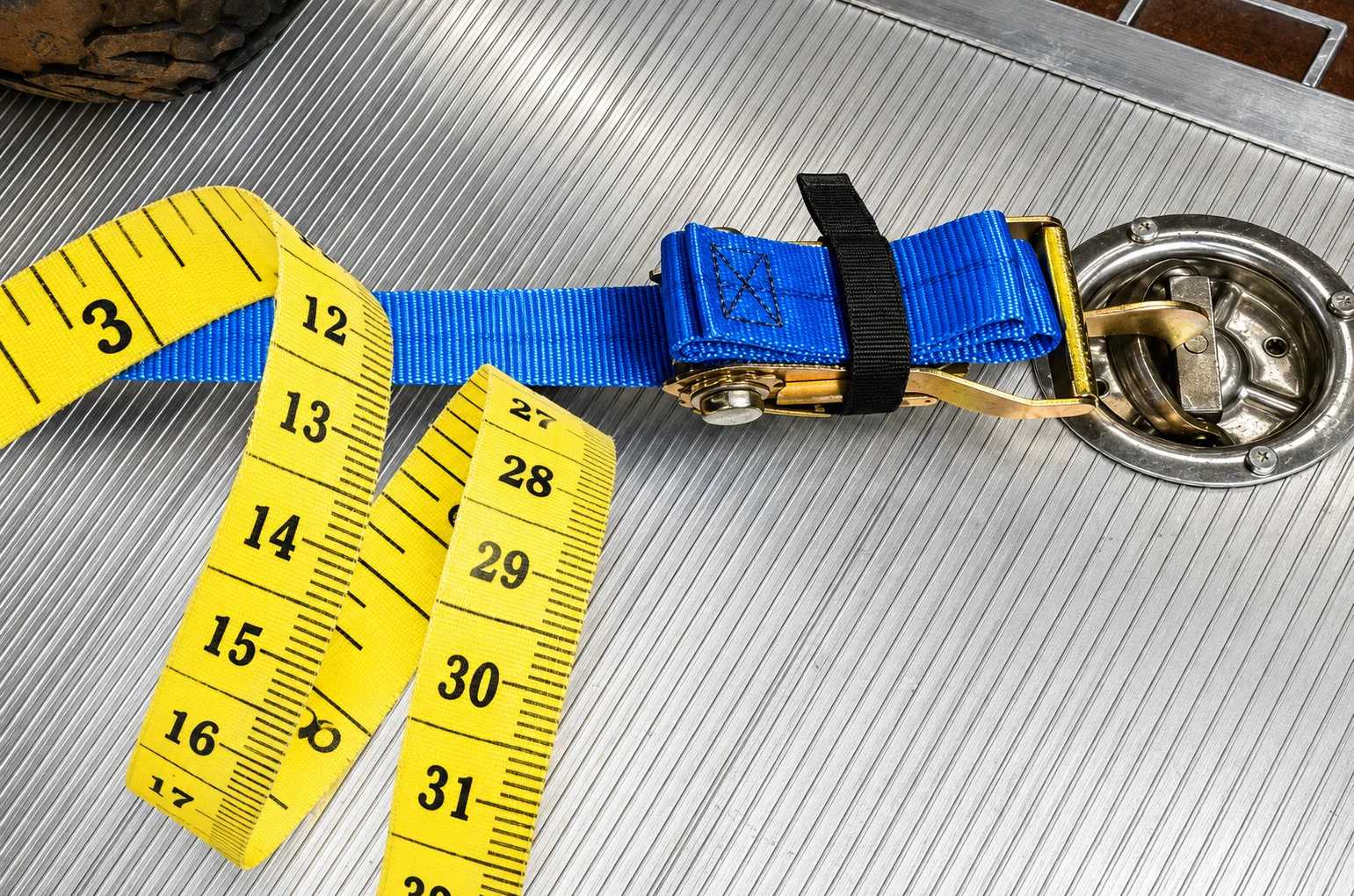
Use photographs with a ruler and a marked reference, plus a dimensioned drawing where available. Measurement helps identify obvious mismatches but does not establish a load rating or approve a connection.
A keeper is not a guarantee against disengagement
Some S-hooks have a spring-loaded keeper or other feature intended to help retain engagement under the conditions described by the manufacturer. A keeper can be obstructed, damaged or incorrectly closed; it should not be described as making a connection impossible to open or disengage. Confirm that it can close as designed and is suitable for the anchor and expected movement.
Similarly, a vinyl or other coating can affect contact with surfaces, but it is not proof that a hook will never scratch or damage an anchor. Check the manufacturer's instructions and the actual contact conditions. Do not load a gate or keeper as though it were the hook's bearing surface unless the fitting is specifically designed and documented for that use.
Component strength is not the finished assembly's WLL
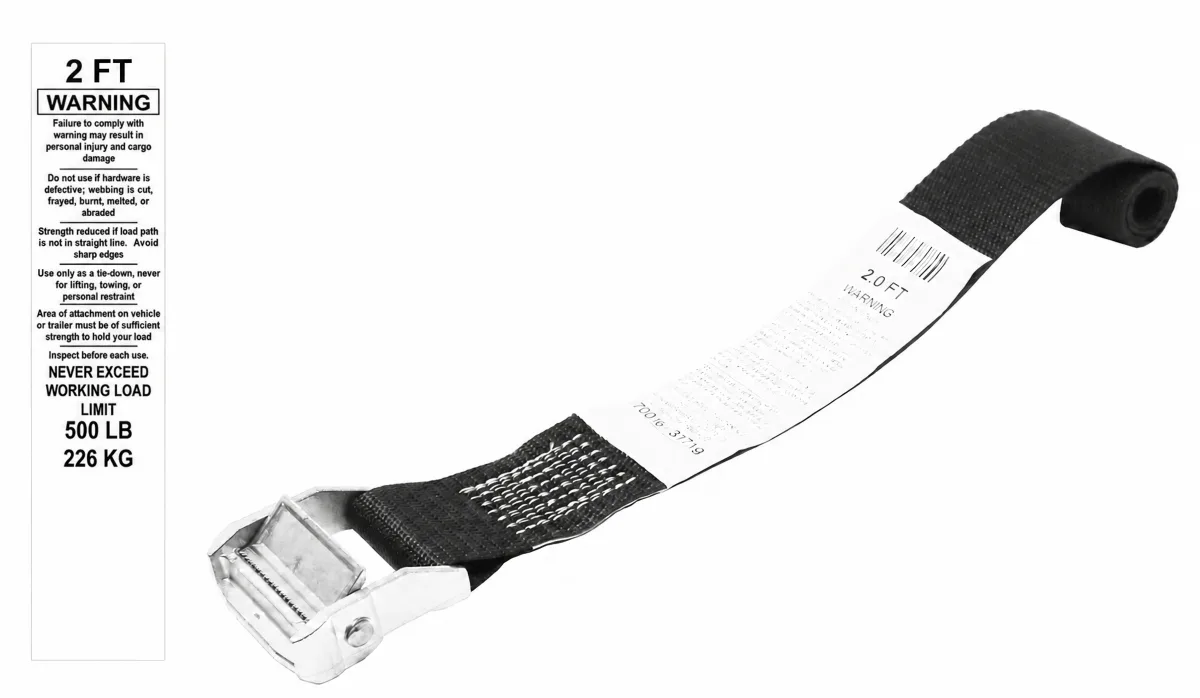
A tie-down can include webbing, stitching, a ratchet or cam buckle, and two fittings. A strength value for one hook describes that component under its stated conditions; it does not establish the rating of a finished strap or the strength of its anchors. Request the identification, WLL, applicable instructions and available supporting records for the exact assembly and end-fitting configuration.
Our explanation of working load limit versus breaking strength covers the distinction. In an actual securement system, also evaluate the other components and attachment points under the applicable rules and manufacturer's instructions. Never calculate a finished assembly's WLL by applying an assumed divisor to an unverified hook value.
Check the strap path and contact areas
The fitting must work with the entire route from one connection point to the other. A different hook shape can change where the strap sits, how much clearance the ratchet has and whether the webbing contacts an edge. Follow the intended route over or around the cargo and check the operating space for threading, tensioning, inspection and release.
Where webbing contacts cargo edges, use protection appropriate to the application and follow the manufacturer's instructions. FMCSA's overview states that edge protection is required in covered operations when a tiedown would be subject to abrasion or cutting at a cargo contact point. For length and fixed-end considerations, see how to choose ratchet strap width and length.
Avoid modifying a hook, bending it to fit, cutting and resewing webbing, or swapping an end fitting while retaining the original assembly rating unless the manufacturer has an approved process for the exact product. A general tie-down fitting is not automatically suitable for lifting, towing, recovery or life-safety applications.
Questions to include in a sourcing inquiry
Provide the supplier with the target market and intended application, a drawing or photograph of each anchor, the available opening or edge dimensions, and the intended pull direction. State whether you need a keeper, what clearance is available, and how the webbing will be routed.
For each proposed SKU, request:
- The exact hook style, drawing, dimensions, material and closure or retention description.
- The approved strap width, attachment method, opposite fitting and finished assembly configuration.
- The complete assembly's assigned WLL, identification, intended use and operating instructions.
- Available records supporting the proposed claims, clearly separated into component and assembly documents.
- A representative sample and a review process for changes to the hook, keeper, webbing or stitching before repeat orders.
Browse tie-down hardware and the product range, then send an inquiry with your anchor images and the intended assembly. Request confirmation of the exact interface before approving an order or a product listing.