A useful custom tie-down strap RFQ tells the supplier what the finished assembly must do, where it will attach, how it will be identified and how the buyer will assess the proposed design. Start with the application and the complete assembly—not only a webbing width or a target breaking strength. If a detail is unknown, mark it for supplier review rather than guessing.
For US importers, distributors and private-label buyers, a clear request also makes competing quotes easier to compare. The checklist below covers the information to gather before ordering samples, along with an illustrative request you can adapt to your own project.
1. Describe the application and destination market
Identify the cargo or equipment, the type of vehicle or storage environment, the intended direction of restraint and how the strap will attach. Include the destination countries and whether the product is for a commercial transport application, retail resale or another defined use. Describe exposure to outdoor conditions, abrasion, chemicals or heat only where those conditions are relevant and known.
Send a drawing or clear photographs of the load path and anchor points. Identify any sharp edges, moving components and areas where the buckle must remain accessible. If several customers will use different vehicles or anchors, explain that variation instead of describing one sample setup as universal.
Ask the supplier which standards, instructions and documentation are appropriate for the specified market and application. For relevant US commercial motor vehicle operations, the FMCSA cargo securement rules address the securement system as a whole. Product selection alone does not establish that a particular load is properly secured.
2. Define the complete assembly and measurements
State whether you need a ratchet, cam buckle or endless configuration. List the webbing, buckle, each end fitting, protective sleeve or other requested component. Specify each end separately when fittings differ. An endless assembly has a different attachment arrangement from a two-piece assembly with hooks, so the quotation should identify the configuration clearly.
Give the desired webbing width, overall length and, where relevant, the fixed-end length. Define the measurement endpoints and whether the measurement includes hardware. Provide units, tolerances or ask the supplier to propose tolerances. Note the clearance available to operate and release the buckle. Our width and length guide explains why both webbing length and fixed-end placement matter.
For a reference point, compare the proposed configuration with a published endless ratchet strap or the broader ratchet tie-down range. A catalog example is a starting point for discussion, not evidence that a modified assembly has the same rating or features.
3. Show the anchor and end-fitting interface
Name the requested hook or fitting and provide the shape, thickness and opening of the intended attachment point. A side view and a measurement reference are often more useful than a fitting name alone. Identify whether a gate or retention feature is needed and whether the fitting can seat correctly without loading its tip or interfering with surrounding structure.
Check that there is room for the fixed end, webbing path and tensioner. If the load touches the webbing at an edge, describe the contact and ask about suitable edge protection. Do not assume a component will fit every rail, ring or anchor simply because it has the right general name.
4. Separate working load limit, breaking strength and verification
State the required working load limit for the finished assembly, the intended method of use and the evidence you need the supplier to provide. Identify whether a stated number is a target or an already verified property. Ask how the finished configuration will be identified and what documentation is available for it.
Breaking strength and working load limit describe different things. A webbing roll's breaking strength, a hook rating or a buckle specification does not by itself establish the working load limit of the complete assembly. Do not assume a single conversion factor applies to every product or market. Our working load limit and breaking strength guide explains the distinction.
If your customer requires a named standard, revision, test method or report, put that requirement in the RFQ and ask the supplier to confirm what applies to the exact design. The Web Sling and Tie Down Association describes its synthetic web tie-down recommended specification; reference to a standard is not proof that a particular product has been tested or certified to it. Agree on the evidence and acceptance criteria before committing to production.
5. Specify appearance, labels and instructions
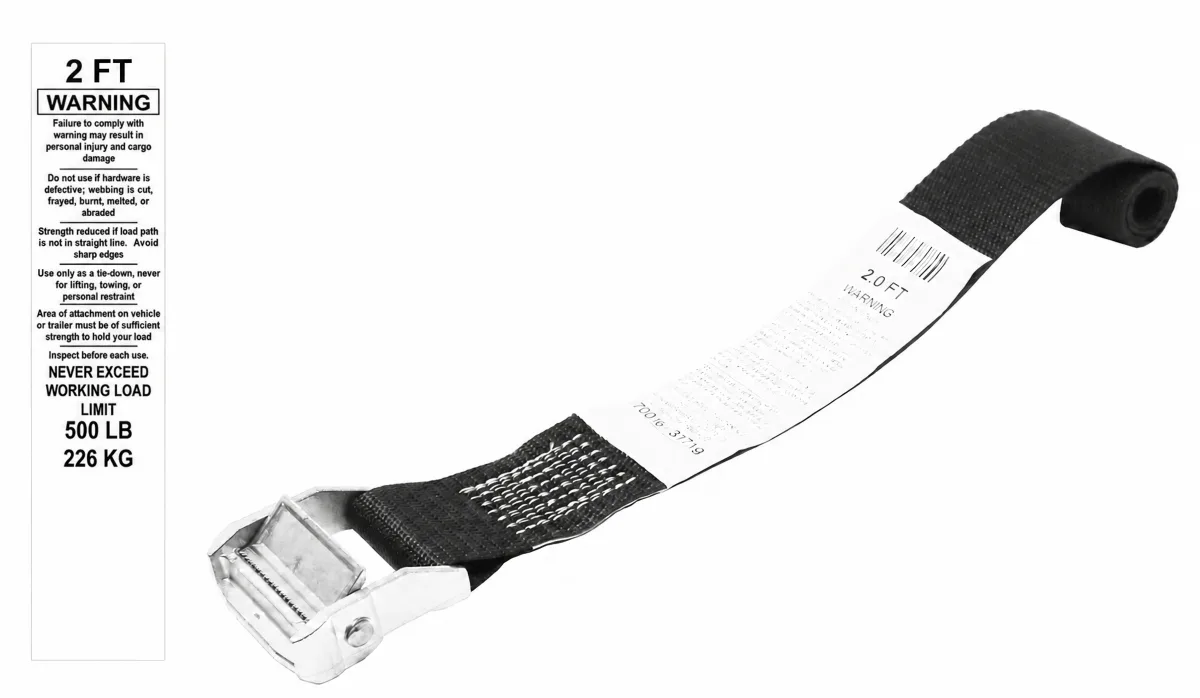
List the desired webbing color, artwork, logo placement and any part number or barcode. Supply artwork with dimensions and identify which information must remain legible on the finished product. For label copy, distinguish your commercial branding from the manufacturer's identification, rating information, warnings and instructions that may be required or recommended for the product and market.
Ask to review a label and packaging proof alongside the sample. Do not write a claim of certification, compliance or performance into the artwork until its basis is confirmed. If the assembly is not intended for lifting or recovery, communicate that use boundary in the product information as appropriate.
6. Make the commercial request comparable
Provide the quantity per configuration, desired sample quantity, packaging unit, carton requirements and destination. State your target delivery date and any required shipping or documentation terms; ask the supplier to confirm what is feasible. Separate firm requirements from preferences so that an alternative can be quoted without silently changing the design.
Ask for a line-item quote that identifies the assembly revision, unit of sale, packaging, sample and tooling charges if applicable, and proposed lead time. Confirm minimum order quantities, artwork charges and delivery terms directly for your project. None should be assumed from a different product or customer order.
7. Use a simple RFQ example
The following is an illustrative information format, not a real product specification or a safe-load recommendation:
- Application: securing a defined packaged item to a specified vehicle; destination market United States.
- Configuration: two-piece tie-down with a requested tensioner and two identified end fittings; supplier to review the anchor drawings.
- Dimensions: requested webbing width, overall length and fixed-end length; measurement endpoints and tolerances to be agreed.
- Performance: target finished-assembly working load limit supplied by the buyer; supplier to confirm feasibility and supporting documentation.
- Identification: proposed label content, brand artwork and part number submitted for review.
- Order: requested sample and production quantities, packaging unit, destination and target delivery date.
- Open questions: suitable fitting, protective materials, applicable documents and any proposed alternatives.
Replace each description with your own measured requirements. Avoid inventing a load value to complete the form: if the required rating has not been determined, identify it as an open engineering question.
8. Approve the sample and record changes
Check the delivered sample against the agreed drawing and bill of materials: configuration, dimensions, fitting interfaces, label, instructions and packaging. Review the actual operating clearance and intended anchors under the relevant equipment instructions. A visual fit check is not a substitute for the performance verification agreed for the assembly.
Record the approved sample and specification revision. For repeat orders, ask to review proposed changes to webbing, hardware, construction, labels or packaging before substitution. Keep the quote, approved artwork and supporting documents together so that purchasing and quality teams refer to the same version.
Ready to discuss a project? Review our OEM and ODM service and send an inquiry with the application, anchor drawings, desired specifications, quantity and target delivery date. Mark unresolved points clearly so they can be reviewed with the supplier.