
Choose a ratchet strap by matching the complete assembly's rating, fitting style and usable length to the actual securement plan. Webbing width is one dimension of that assembly; it does not by itself establish a working load limit. Length must accommodate the route between the connection points, the fixed end and the manufacturer's operating requirements—not just the straight-line distance across the cargo.
For an importer, distributor or brand buyer, the most useful order specification records the application and the dimensions together. Start with the cargo, anchors and intended strap path, then ask the supplier for the rating, length definition, fittings and instructions for the exact assembly being considered.
Start with the load and its securement plan
Record the cargo's size, weight, shape and surface sensitivity, the vehicle or equipment used, and the available attachment points. Identify how the cargo will be restrained against movement and where each proposed strap will travel. Different loads can require blocking, bracing, additional devices or specific methods; a strap that physically reaches is not automatically suitable.
The assembly and its connections must suit the forces and conditions of the real application. For US commercial transport covered by the rules, the FMCSA cargo securement overview discusses system strength, attachment, edge protection and commodity-specific requirements. This article helps define strap dimensions; it does not calculate a universal number of straps or replace the applicable securement plan.
Measure the actual route, not only the cargo width
With the intended vehicle and load identified, mark the strap's path from its first connection to its second connection. Follow the route up, across or around the cargo and down to the other attachment point. Include changes in direction and any protection that occupies space along the route. A tape laid over a representative load can help document the path, but the operator must also be able to connect and operate the selected assembly correctly.
Record the location and bearing interface of each fitting. A hook's usable connection position is not necessarily the outer tip; ask the supplier to show its measurement reference on the drawing. Check the compatibility and condition of the anchors and fittings. The fact that a hook fits an opening does not establish that the connection is suitable.
An endless strap is measured and used as a loop around the items being bundled; it has no separate hook at each end. It does not automatically attach that bundle to the vehicle. When comparing an endless ratchet strap with a hook-end assembly, define each route and its connection method separately.
Fixed end, adjustable end and overall length
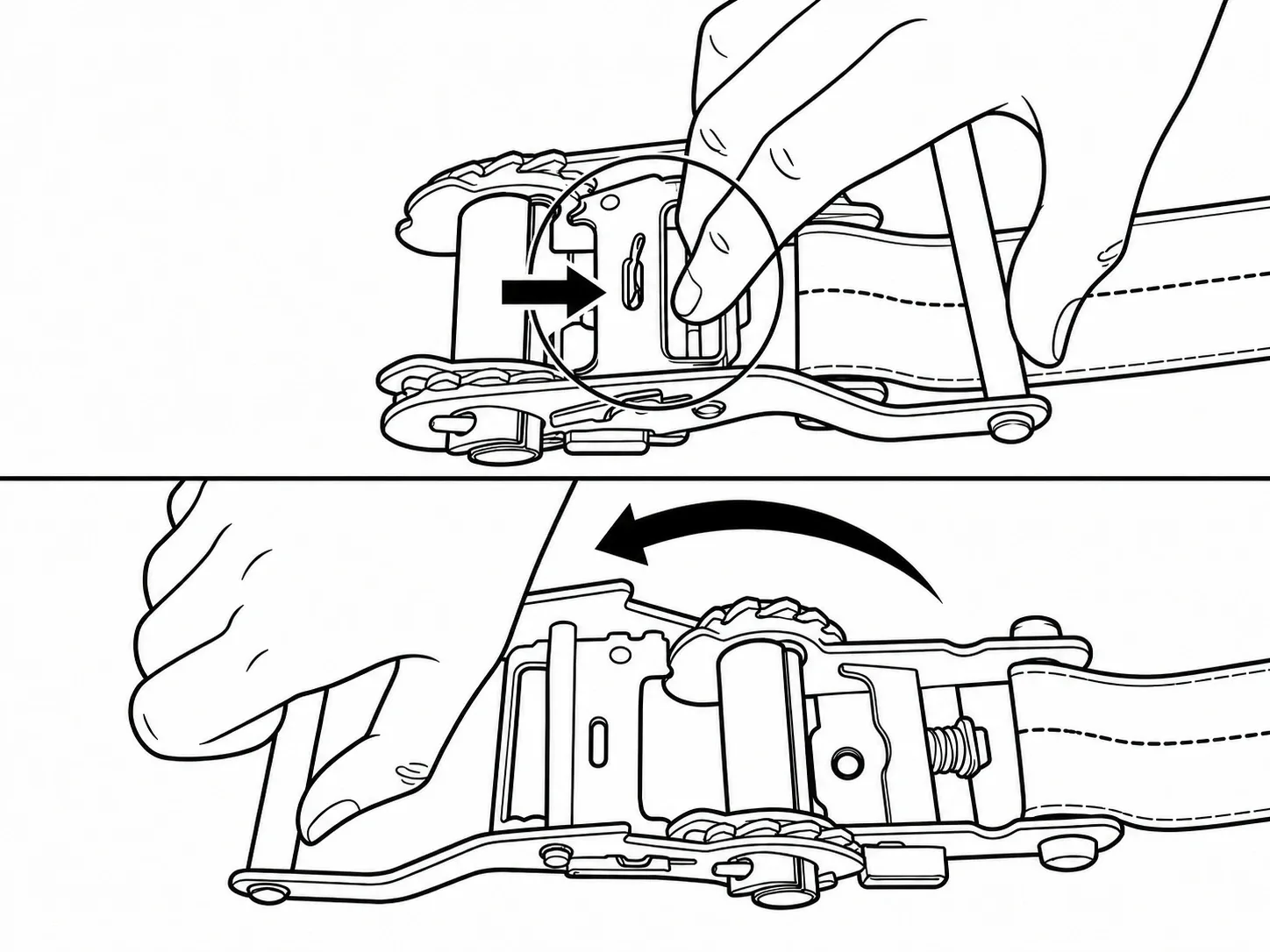
Many hook-end ratchet straps have a shorter fixed end associated with the ratchet and a longer adjustable end. The fixed end determines where the ratchet can sit relative to its anchor. A fixed end that places the mechanism against a cargo edge or inside an inaccessible recess can make an otherwise long-enough assembly a poor fit.
Ask the manufacturer to identify:
- Overall or nominal length: What reference points are used, and are end fittings included?
- Fixed-end length: From which point on the fitting to which point on the ratchet is it measured?
- Adjustable-end length: What portion of webbing is available, and how is it measured?
- Usable adjustment range: What conditions and remaining webbing are required for the exact ratchet model?
- End-fitting dimensions: What are the fitting type, opening and intended connection interface?
Do not add fixed and adjustable lengths unless their measurement endpoints and any overlap are understood. The webbing needed in the mechanism is not necessarily the same as free length available along the cargo path. Follow the model's instructions for threading and the permitted number of wraps; do not assume one universal wrap count for every ratchet.
Allow enough working length without creating a management problem
Once the physical path is measured, discuss working allowance with the supplier. The selected assembly needs sufficient adjustable length for connection, threading, proper operation, and the approved routing. The needed allowance depends on the specific mechanism, end fitting, cargo geometry and instructions; there is no single extra-length percentage that works for every load.
For an illustrative measurement only, a buyer might record a route as three sections: 3 feet from the first connection to the top of the load, 4 feet across it, and 3 feet to the second connection. The documented path is therefore 10 feet. That number is not a recommended strap length: the buyer still needs to define the fixed-end position, fitting reference points, threading requirements and any working allowance with the manufacturer.
A strap that is much longer than needed can leave a free tail that must be managed. Ask how the manufacturer instructs users to secure excess webbing and how the assembly will be stored between uses. Do not solve excess length by knotting the load-bearing webbing or altering the strap unless the manufacturer's instructions explicitly permit the action.
Width affects fit; the assembly rating governs selection
Webbing width helps determine whether a strap can pass through the intended clearance, sit on an appropriate contact area, and match its tensioner and fittings. A wider strap is not automatically suitable, stronger, or gentler in every situation. Webbing material, construction, stitching, hardware and the configuration of the complete assembly all matter.
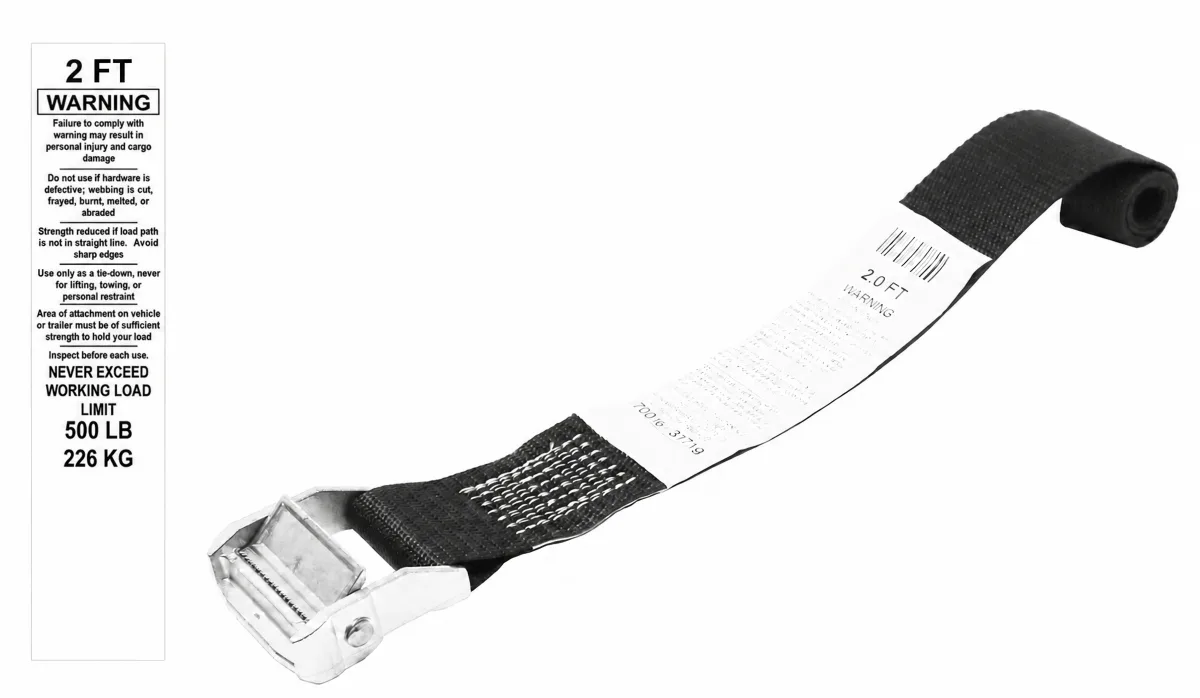
Compare the manufacturer-assigned working load limit (WLL) of the exact finished strap and the limitations of its attachment points and other components. Do not derive a WLL from width, a component's rating, or a product's breaking-strength figure. Our guide to working load limit versus breaking strength explains how to distinguish the values when reading a label.
For a procurement comparison, record the width together with the complete model identification and its documented WLL. This prevents a webbing-width shorthand from being mistaken for a strength specification on a purchase order or retail label.
Check clearance and contact before approving the size
Place a representative assembly in the proposed orientation without applying an unsafe load. Check whether the ratchet handle has room for its required movement, locking and release; whether the operator can reach it; and whether the webbing can remain correctly aligned. The user must be able to stabilize the load and access the mechanism when it is time to release tension.
Review the cargo surface and every point where the webbing or hardware touches an edge. Use protection suitable for the specific contact and follow the cargo and equipment instructions. For applicable US commercial operations, FMCSA specifies edge protection where a tiedown would be subject to abrasion or cutting at the contact point. A wider strap does not remove that requirement or guarantee that a fragile surface will be undamaged.
For the operating sequence, consult how to use ratchet straps, then follow the instructions supplied with the actual model. Remove damaged or malfunctioning equipment from service in accordance with those instructions and applicable rules.
What to put on a buyer's specification sheet
Use one record for each proposed configuration. Include:
- Intended cargo, market, operating environment and the applicable securement requirements.
- The measured strap path, connection locations, obstacles and contact surfaces, with photographs or a drawing.
- The finished assembly's WLL, identification, label and relevant instructions, including any required supporting documentation.
- Webbing width and material, overall length, fixed-end and adjustable-end dimensions, with named measurement endpoints and tolerances.
- End-fitting type and interface, ratchet position, required handle clearance and any protection required.
- Tail-management, packaging and identification requirements for the intended user.
- The sample and drawing revision approved by the buyer, plus a process for reviewing proposed changes before reordering.
Ask the supplier to clarify whether a stated figure applies to loose webbing, a component, or the finished assembly. Do not assume a published rating for one configuration applies to another end fitting, stitch pattern or length.
Request a model-specific recommendation
Browse the ratchet tie-down strap range. To discuss a distribution or private-label requirement, send an inquiry with your cargo dimensions, measured route, required assembly WLL, anchor details, fixed-end preference and handling requirements. Request the exact model's specification and instructions before approving the size or product listing.